
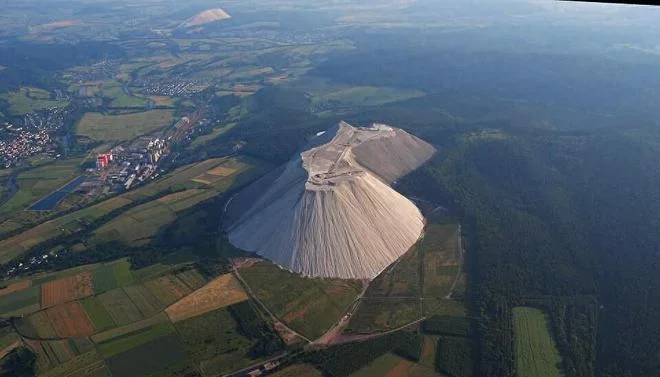
Humanity’s capacity to reshape nature is starkly illustrated by this almost entirely salt-built mountain in Germany. Located near the town of Heringen in the state of Hesse, the Monte Kali salt pile covers over 100 hectares (1 square kilometer) and contains an estimated 236 million tons of salt. 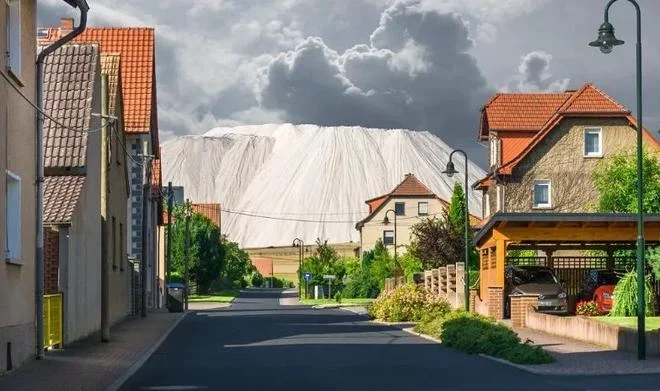
The pile is composed primarily of sodium chloride—common table salt—with a purity of 96 percent. Its brilliant white appearance and height of more than 250 meters above the surrounding landscape make it resemble a snow-capped peak from a distance. 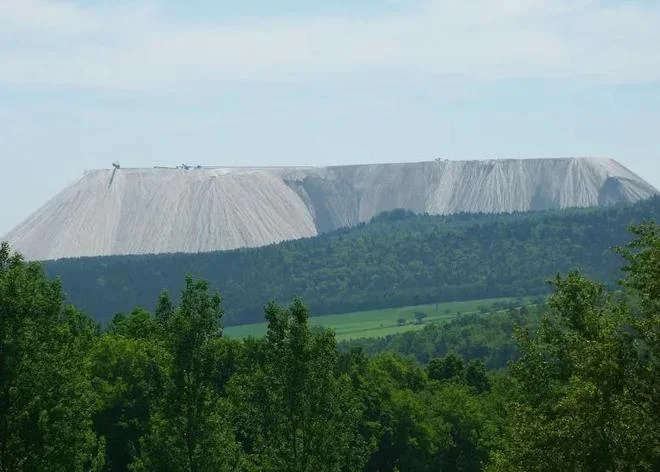
However, this is no natural formation. It is the accumulated byproduct of industrial potash mining, a process that began in 1903 when the Wintershall potash plant started operations in the region. Potash ore contains only 20 to 35 percent potassium; the remainder is largely sodium chloride. For every ton of potash produced, several tons of sodium chloride waste must be disposed of.
Initially, this salt waste was scattered across many small piles. But in 1973, Wintershall merged with another company to form K+S, now Europe’s largest potash supplier. Under the new company, waste disposal was centralized, and the Monte Kali site became the primary dumping ground. Since 1976, K+S has been depositing all its sodium chloride waste here at a rate of approximately 900 tons per hour—or 7.2 million tons per year.
To achieve this, a 1.5-kilometer conveyor belt was built, running from ground level to the top of the pile, continuously carrying waste salt to be dumped over the edge. The pile’s height is limited by its fixed footprint, so it has grown increasingly tall. In 2020, K+S secured an extension of its potash mining license until 2060, along with permission to expand the salt pile by 25 hectares. Thus, future growth will likely be in area rather than height.
Monte Kali has become a local landmark, earning the region the nickname “Land of the White Mountain” and attracting around 10,000 visitors per year who pay to climb the salt hill in about 15 minutes. Yet this “landmark” is far from celebratory. It has caused severe ecological damage. Research shows that the salt pile leaches brine into the soil, rivers, and groundwater, rendering the surrounding land barren. The original vegetation has disappeared, replaced by only a few salt-tolerant species. The area’s invertebrate population has plummeted from 60 to 100 species to just three.
Despite the ecological devastation, potash mining persists out of economic necessity—thousands of local jobs depend on it.