
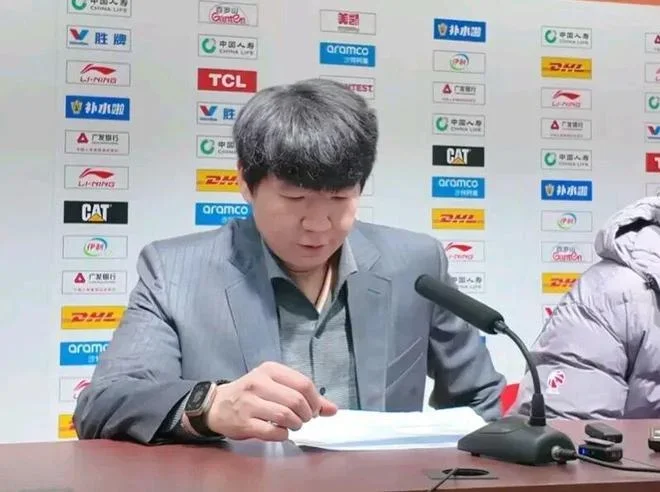
The lights in the press conference room were bright enough to reveal the stubble on Qiu Biao’s chin. He sat there in the same suit, but his tie was loosened a notch. This was his last time in that seat for the season, and he had likely anticipated it. After losing to Shanghai by 40 points, anyone would feel embarrassed, but he deliberately laid it bare: “Scoring this many points, the coach definitely takes the primary responsibility.” The words sounded like a confession, but they carried a steely resolve.
“I can accept everything.” Five words, lightly dropped from the microphone, hit the table with a thud. Journalists paused their pens mid-stroke. What does “everything” mean? Salary cut? Contract termination? Packing up for next season? He didn’t spell it out, but the implication was clear. This didn’t sound like a coach who had just led the team to the quarterfinals; it sounded like a man writing his will in advance.
I watched him throughout the press conference. Since the losing streak at the end of the regular season, Qiu had shown vulnerability. He spoke of being “heartbroken” and “disappointed,” and I felt then that he was different—not in tactics, but in his willingness to expose his weaknesses. In Chinese basketball, coaches who lose either blame foreign players or criticize young players. But Qiu talked about “insufficient spiritual support,” a rare admission. He counted injuries: Tao Hanlin played only five games, Gao Shiyan returned with a nagging injury, Chris played through surgery, and Yu Dehao had knee swelling. As he counted, his eyes reddened. This was not acting—if it were, it would be too clumsy. A 43-year-old man nearly breaking down in front of reporters meant the air had long gone out of him during the final road games of the regular season. Losses in Ningbo, Shanxi, Shanghai, and Beijing—four consecutive defeats, each more frustrating than the last. He must have known then that the tank was nearly empty.
But I must speak fairly for Qiu Biao. When he took over Shandong two years ago, his first move was to instill “speed” into the team’s DNA. He elevated young players like Gao Shiyam’s steals and counters, Chen Peidong’s off-ball movement, and Xie Zhijie’s defensive tenacity—gems he unearthed from the bench. Third place in the regular season, Shandong’s best result in a decade—that credit cannot be erased. But the playoffs use a different algorithm. The seven-game battle against Liaoning exhausted everything. Tao Hanlin played over 30 minutes per game, a 34-year-old veteran charging into the paint as if his knees were filled with lead. Gao Shiyam was worse—rushed back from injury, his offensive steps heavy as if wading through mud. Qiu said he “didn’t want to see” them playing so many minutes, but who sat on the bench? Mi Aili? Zheng Xiaoyao? Or Ma Yandong, who couldn’t even make the roster? He did try to develop young players during the regular season—he tried, but they didn’t break through. This is not just Qiu’s fault; it’s the debt of Shandong basketball’s broken youth pipeline over a decade, and it will take time to repay.
Now the most awkward situation lies with Shandong High-speed management. If Qiu leaves, who do they bring in? Wang Han? He did well in Jilin last year, but his style is slower and doesn’t fit Shandong’s personnel. Yang Ming? Still contracted with Liaoning. Du Feng? Too tied up with Guangdong. Among mid-generation coaches with talent and willingness to wade into Shandong’s troubled waters, you can count them on one hand. Moreover, Qiu’s team-building approach is correct. He knows Shandong doesn’t have the strength to win a championship in the short term, so he focuses on defense and details, turning an average-talented team into a cohesive unit. This rugged style isn’t pretty, but it’s effective. Changing coaches would waste another year or two rebuilding.
At the end of the press conference, a reporter asked about his plans for next season. Qiu smiled and didn’t answer. The smile carried fatigue, resignation, and a hint of unwillingness. I remembered him eating at the Shandong Provincial Sports Bureau canteen early in the season, chatting with chef Ji about the saltiness of the sauce, sitting with players and tearing bread. Back then, there was light in his eyes, believing this team could achieve something. Now the light remains, but it’s dimmed.
“I can accept everything”—these words shouldn’t come from a coach’s mouth. They should come from management: “We accept you, Coach Qiu. We accept your failure, your trial and error, and the two years you’ve spent pulling Shandong basketball out of the mud.” Competitive sports have no patience, but rebuilding a team must. Qiu needs more time, and Shandong needs it too. Don’t wait until he’s gone to remember the nights he spent alone in the empty training hall, drawing tactical lines on the board until dawn. No one saw that, but those lines are etched into the bones of this team.